
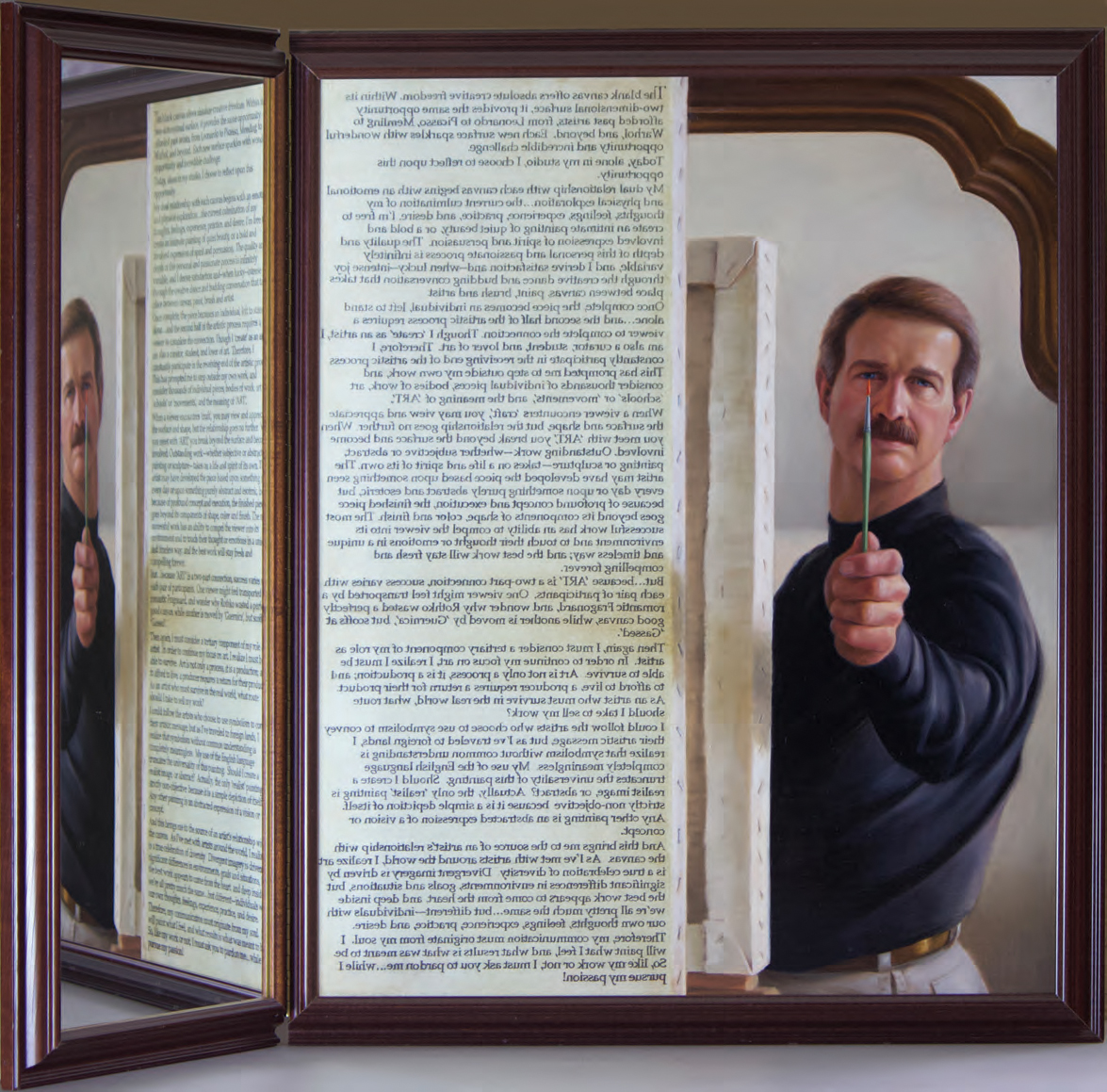
The artist William A. (“Bill”) Suys, Jr., is a longtime friend of Fine Art Connoisseur, sister publication to Realism Today. William alerted us to a fascinating self-portrait painting he made two decades ago, “Self-Thoughtrait,” which contains the text you see below.
He recalls, “I decided to include the blank canvas in my composition. As I began painting, I was filled with an array of thoughts and feelings while the blank area was also calling for attention, so I decided to include an essay as an integral part of the self-portrait. I built the frame with a piano hinge and mirror so that people can read the copy when viewing the piece in person.”
Bill not only wrote these wise words to convey his personal take on artistry, he also painted them backward so they can be read in their entirety only in the mirror’s reflection. This is the first time the words have appeared in print, surely easier than lifting the painting with your back to a mirror! Read on, and enjoy.
Self-Thoughtrait
By William A. Suys, Jr.
The blank canvas offers absolute creative freedom. Within its two-dimensional surface, it provides the same opportunity afforded past artists, from Leonardo to Picasso, Memling to Warhol, and beyond. Each new surface sparkles with wonderful opportunity and incredible challenge.
Today, alone in my studio, I choose to reflect upon this opportunity.
My dual relationship with each canvas begins with an emotional and physical exploration… the current culmination of my thoughts, feelings, experience, practice, and desire. I’m free to create an intimate painting of quiet beauty, or a bold and involved expression of spirit and persuasion. The quality and depth of this personal and passionate process is infinitely variable, and I derive satisfaction and — when lucky — intense joy through the creative dance and budding conversation that takes place between canvas, paint, brush, and artist.
Once complete, the piece becomes an individual, left to stand alone … and the second half of the artistic process requires a viewer to complete the connection. Though I “create” as an artist, I am also a curator, student, and lover of art. Therefore, I constantly participate in the receiving end of the artistic process. This has prompted me to step outside my own work, and consider thousands of individual pieces, bodies of work, art “schools” or “movements,” and the meaning of “Art.”
When viewers encounter “craft,” they may view and appreciate the surface and shape, but the relationship goes no further. When you meet with “Art,” you break beyond the surface and become personally involved. Outstanding work — whether subjective or abstract, painting or sculpture — takes on a life and spirit of its own. The artist may have developed the piece based upon something seen every day or upon something purely abstract and esoteric, but because of profound concept and execution, the finished piece goes beyond its components of shape, color, and finish. The most successful work has an ability to compel the viewer into its environment and to touch their thought or emotions in a unique and timeless way; the best work will stay fresh and compelling forever.
But… because “Art” is a two-part connection, success varies with each pair of participants. One viewer might feel transported by a romantic Fragonard, and wonder why Rothko wasted a perfectly good canvas, while another is moved by “Guernica,” but scoffs at Sargent’s “Gassed.”
Then again, I must consider a tertiary component of my role as artist. In order to continue my focus on art, I realize I must be able to survive. Art is not only a process, it is a production; to afford to live, a producer requires a return for their product. As an artist who must survive in the real world, what route should I take to sell my work?
I could follow the artists who choose to use symbolism to convey their artistic message, but as I’ve traveled to foreign lands, I realize that symbolism without common understanding is completely meaningless. My use of the English language truncates the universality of this painting. Should I create a realist image, or abstract? Actually, the only “realist” painting is strictly non-objective, because it is a simple depiction of itself. Any other painting is an abstracted expression of a vision or concept.
And this brings me to the source of an artist’s relationship with the canvas. As I’ve met with artists around the world, I realize art is a true celebration of diversity. Divergent imagery is driven by significant differences in environments, goals, and situations, but the best work appears to come from the heart, and deep inside we’re all pretty much the same … but different — individuals with our own thoughts, feelings, experience, practice, and desire.
Therefore, my communication must originate from my soul. I will paint what I feel, and what results is what was meant to be. So, like my work or not, I must ask you to pardon me … while I pursue my passion!
About the Artist
William A. Suys, Jr. is a Master Signature Member of the Oil Painters of America (OPA) and a Signature Member of the Portrait Society of America. His greatest joy is standing behind an easel, indoors or out, brush in hand. Bill creates studio and plein air works in a wide range of genres including portraiture/figurative, animals, landscape/architecture, and still life. He also teaches, judges, lectures, demonstrates, and serves on OPA’s board of directors.
Browse more articles on self-portrait painting, figurative art and artists here at RealismToday.com.