
From historic battleships to modern sailing scenes, this look at American maritime art reveals how artists honor the nation’s seafaring legacy.
By Leslie Gilbert Elman
The history of the United States has always been linked to the water. Coastal areas and countless inland waterways give us outstanding natural beauty and places for relaxation, facilitate transportation and commerce, and assist in our nation’s defense.
The American Society of Marine Artists has always been linked to the water as well. It is the nation’s oldest and largest not-for-profit educational organization dedicated to promoting maritime art and history. Water is the unifying element among the paintings created by members of the American Society of Marine Artists. Beyond that, you might say the definition of marine or maritime art is “fluid,” with the two terms used interchangeably to refer to art depicting life and activity in, on, and around the water.
The Society fulfills its mission by mounting exhibitions at museums across the country; supporting emerging artists in the genre through its Young Marine Artists Search competition; and hosting conferences and events where hundreds gather for painting demonstrations, roundtable discussions, and plein air outings. Both the congressionally appointed, nonpartisan U.S. Semi-quincentennial Commission and, separately, representatives from the Pentagon invited the Society to participate in the celebration of the 250th anniversary of the founding of the United States — the nation’s semi-quincentennial — which will culminate on July 4, 2026. In each instance, the Society was given free rein to contribute in any way it chose.
“It was an honor — and a challenge,” says Nicholas Fox Raposo, the Society’s current president. “How best to demonstrate our humble patriotism and love for this nation and the democratic values it stands for?” The members decided to pursue two related projects that use art to document and celebrate the country’s maritime history.
First was an exhibition of works by Society members at the Pentagon itself in 2024. Open to public view in the corridors of the building, this display focused on depictions of maritime military history from the French and Indian War (1754–63) to the nuclear-powered Nimitz-class aircraft carrier USS Abraham Lincoln (CVN 72) in service with the U.S. Navy. (Because Pentagon security procedures do not permit framed paintings to be brought in, the works in this exhibition were high-quality digital reproductions affixed to the walls unframed.) Editor’s Note: View the exhibition online catalog here.
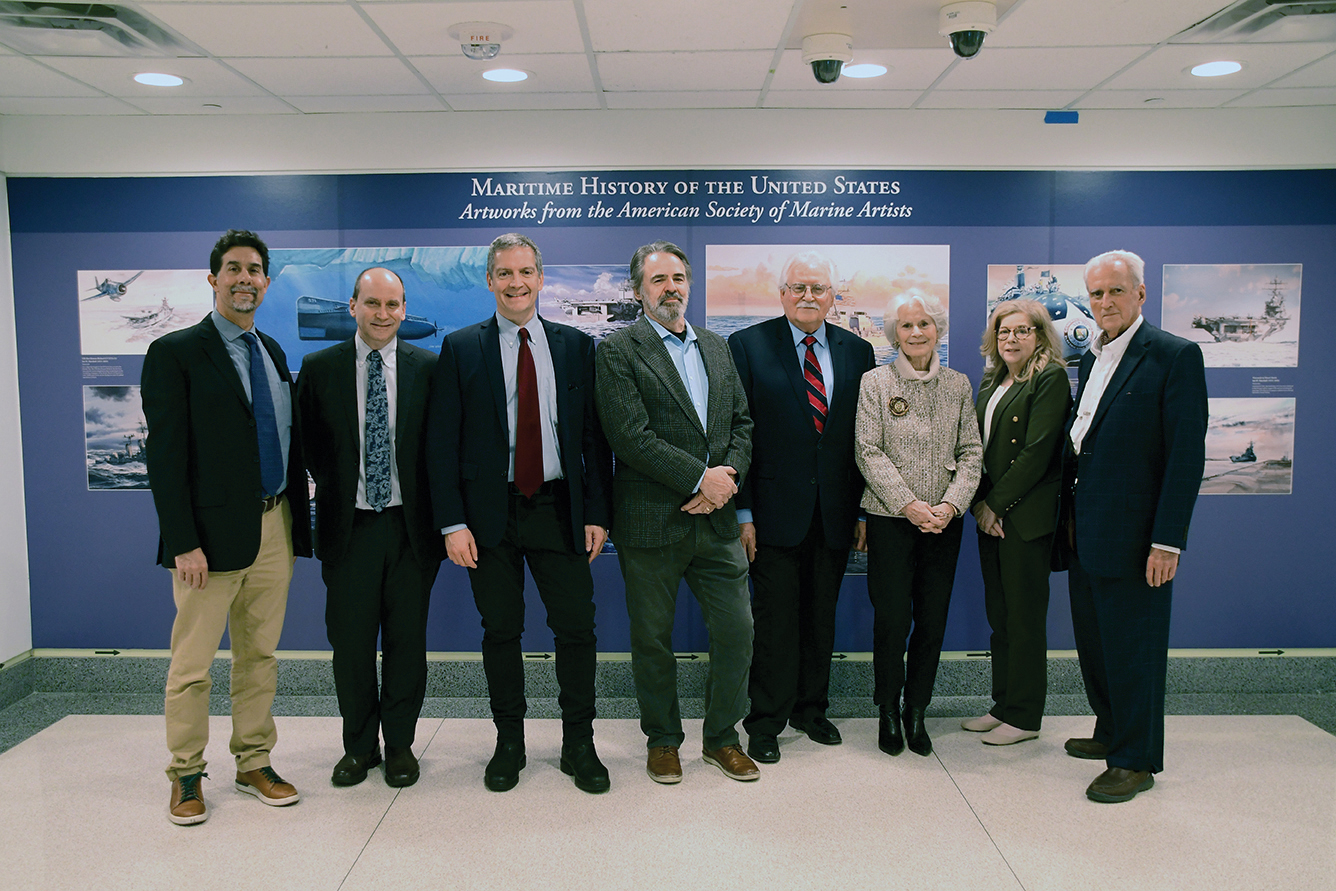
“We’re grateful to the active duty, retired, and civilian personnel who helped make the show happen, including Capt. Chris Christopher [USN, Ret.], and at the Pentagon, Albert Lee Jones, Brenda White, and Kelly Joseph Guerrero,” Raposo says. He adds that the Society’s relationship with the Pentagon began when they collaborated on a 2012 video documentary titled The Naval War of 1812 Illustrated and its companion book, The Naval War of 1812–1815: Foundation of America’s Maritime Might, to mark that conflict’s 200th anniversary.
The second of the Society’s current projects is A Maritime History of the United States: The Creation and Defense of a Nation, an elegant 300-page volume illustrating more than 200 artworks made by its members. Authored by Charles Raskob Robinson (a Fine Art Connoisseur contributing writer) and designed by ASMA member Leonard F. Tantillo, the book goes beyond the Pentagon exhibition to embrace all aspects of U.S. maritime history depicted in art, accompanied by thoughtful descriptive text.
Robinson explains, “We took the bones of what we prepared for the Pentagon and set out to marry three elements: a vast history, existing works done by members that illustrate the story, and an aspiration to present the extraordinary talent of our membership seen in their work over recent decades. The hope is to give the public an under-standing of these contemporary American painters and promote an appreciation of marine art and history.”
Historical Perspective
While the works featured in the book are contemporary, many are unmistakably historical in both their choice of subject and the style in which those subjects are depicted.
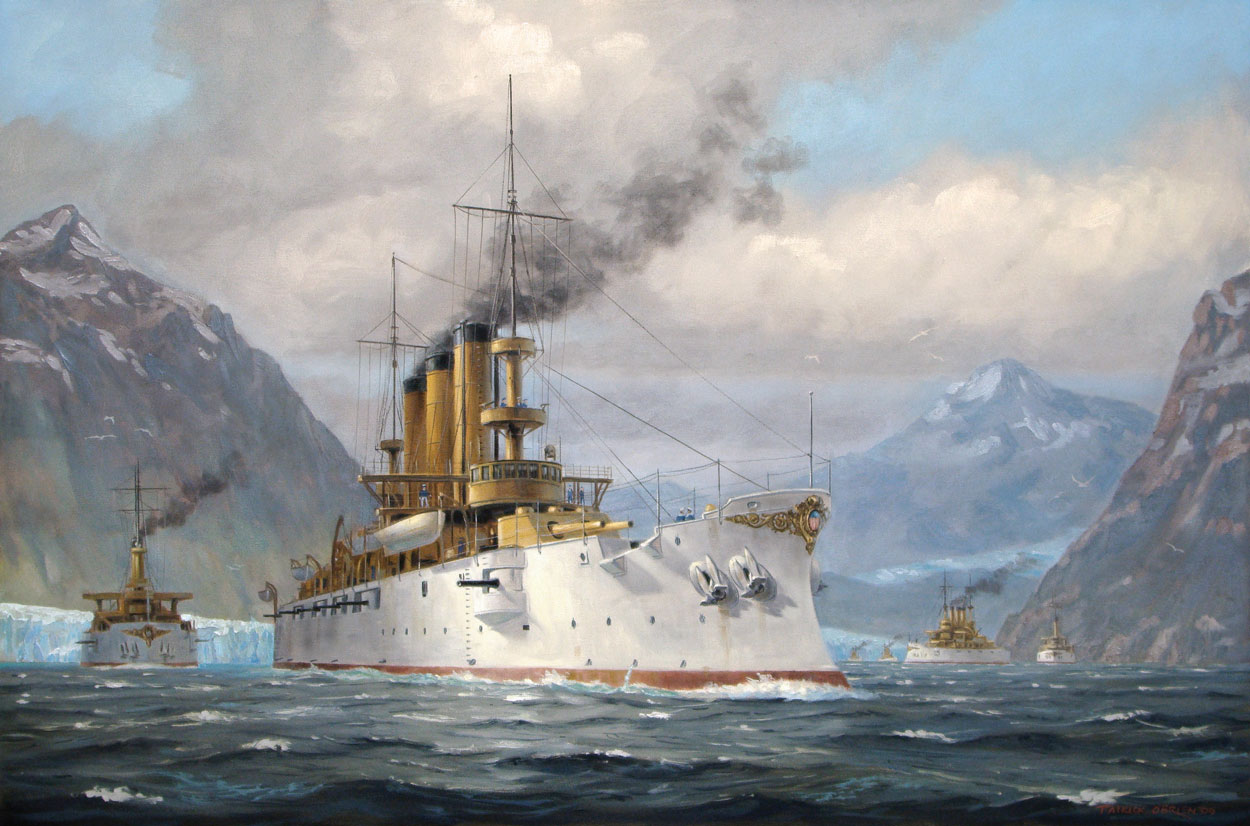
One outstanding example is “The Great White Fleet in the Strait of Magellan” by Baltimore-based artist Patrick O’Brien. Nicknamed the “Great White Fleet” because of their distinctive white hulls trimmed in gold, these 16 battleships were sent by President Theodore Roosevelt on a 14-month voyage, from December 1907 to February 1909, covering 43,000 miles and calling at 20 ports on six continents.
The genesis of O’Brien’s painting began with a 2010 show of his art at the U.S. Naval Academy Museum in Annapolis, Maryland. “I had a chance to go ‘backstage’ at the museum to examine books and ships’ plans and ship models in the collection,” he recalls. “I was particularly taken by models of the Victorian-era battleships because they were so visually striking. I conceived a painting of the Great White Fleet, which the President sent to various friendly countries to demonstrate American naval power. I chose to depict perhaps the most visually striking part of the cruise, the flagship USS Connecticut leading the fleet through the cold and rocky Strait of Magellan [at the southern end of South America] in 1908.”
O’Brien, the Society’s incoming president, specializes in a type of “imaginative realism,” fortifying himself with extensive historical and technical background information in order to paint imagined scenes with realistic accuracy. “My paintings always involve a lot of research, planning, and sketching,” he notes. “In this case, I studied blueprints, photos, and a model of the ship. I also studied maps and photographs of the Strait of Magellan.”
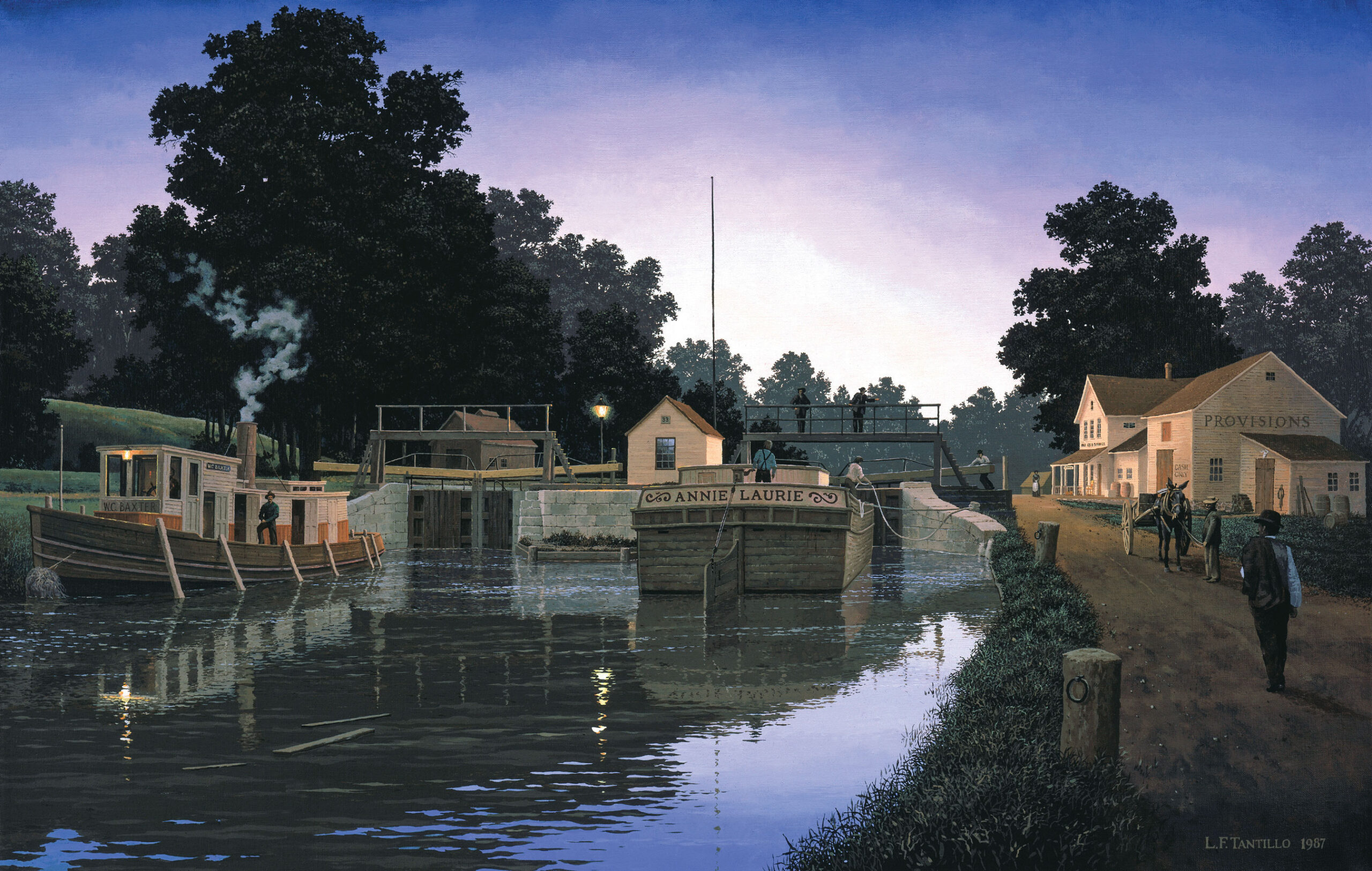
A commitment to research and historical accuracy is evident in paintings throughout the book, whether they depict military events or scenes of civilian life from centuries past or the present day. Leonard Tantillo says he has dedicated the last 40-plus years of his career to the representation of historical subjects, especially those relating to New York State, where he resides. “The Old Erie Canal, 1895” is one of more than 15 he has painted of the canal, which he calls “one of America’s greatest engineering accomplishments of the 19th century.” He says, “In all of my paintings, I want to engage the viewer emotionally. I believe it is the most effective way of getting someone’s attention. Once I achieve that, I can introduce them to my historical subject. In this Erie Canal painting, I want you to feel like you are walking along the towpath at the end of a summer day, in the enchanted light of dusk.”
Maritime News
Through the art illustrating its pages, A Maritime History of the United States reminds readers of the diversity of America’s waterways and the myriad ways they influence our lives, from the quiet beauty of a bird in flight over the Chesapeake Bay to the imposing bulk of massive container ships in port to fishermen and sailors in action.
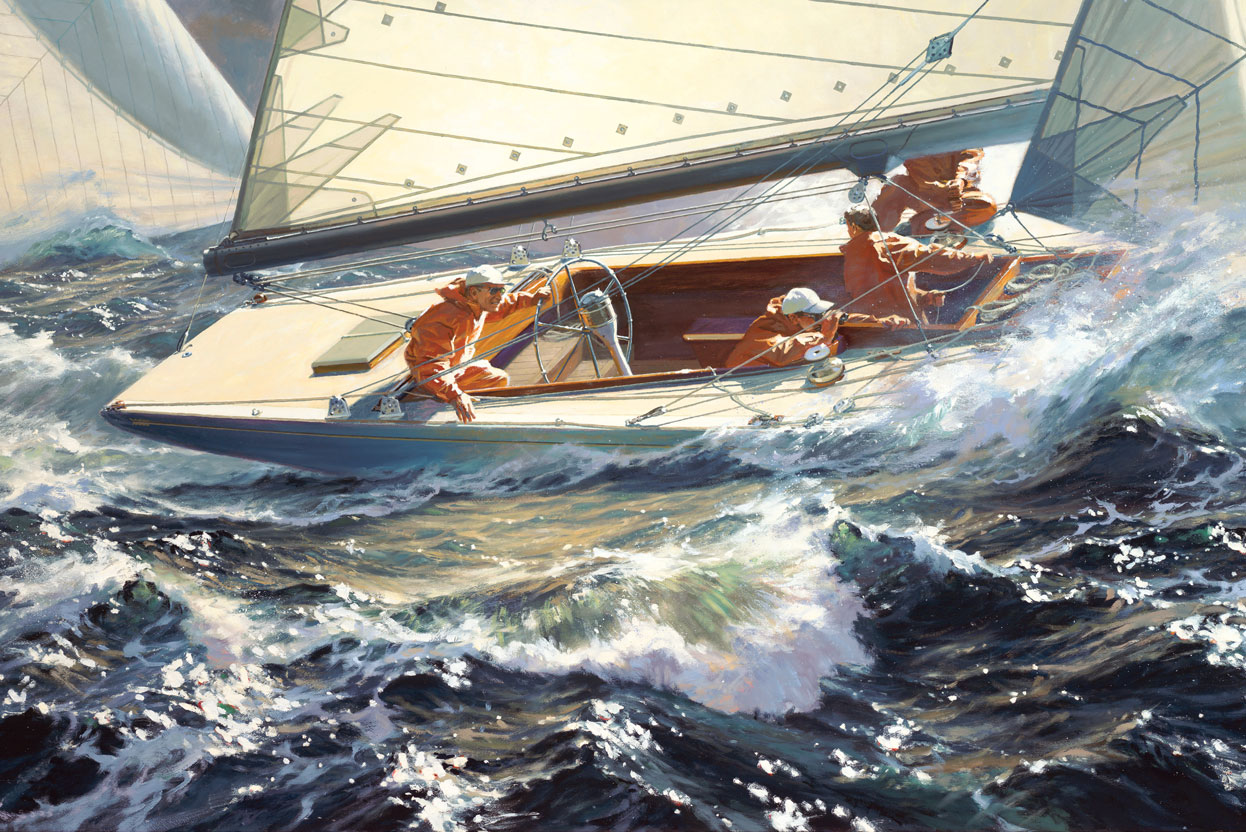
Indeed, some of the book’s most beautiful and dynamic images are those depicting maritime sports and leisure. Russ Kramer’s painting, “Weatherly, 1962,” was the result of a commission from a prominent yachtsman with an extensive collection of art focused on the America’s Cup yacht race. The 1962 race was noteworthy for being the first time Australia competed in the event. Ultimately, the American yacht Weatherly, skippered by Emil “Bus” Mosbacher, Jr., prevailed against a challenge from the Australian yacht, Gretel.
The intensity of the competition appealed to Kramer, who lives and works in Mystic, Connecticut. “I am most drawn to the human element of being on the water, cruising or racing boats, and often look to depict a scene with a strong figurative element,” he says. “In this case the skipper, Bus Mosbacher, was as important to winning the race as the vessel, and thus my emphasis was on him and his intense focus.”
Based in Sarasota, Florida, the artist Judy Saltzman shows a similar passion for the energy and intensity of sailing competition. A U.S. Sailing Instructor and racer, her experience on the water informs both the subject and the emotion of her watercolors, a medium she prefers for “its ability to capture the ever-changing nature and unpredictability of the sea itself.”
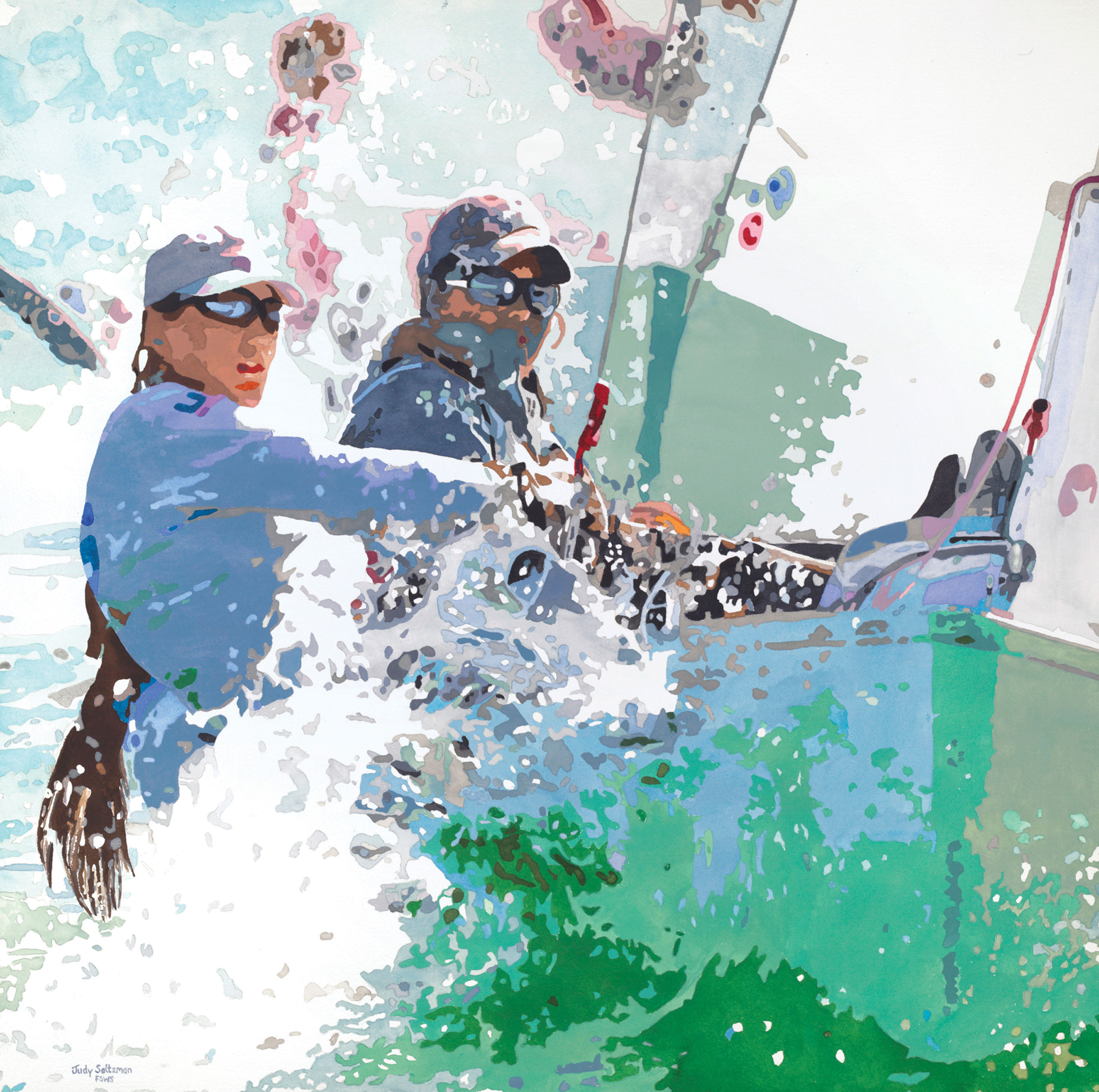
In her painting, “Salty Sisters,” Saltzman depicts a women’s sailing team with that memorable name leading the pack to the weather mark during a race off the west coast of Florida. “I was sitting on the back of the race committee boat to be at the water’s edge,” she recalls. “The image is a combination of photos and drawings. It was a cold, overcast morning for Florida and I added the light direction for dimension. The goal is to have viewers feel the wind in their hair, the spray of salt on their skin, and the adrenaline of sailing.”
Making History
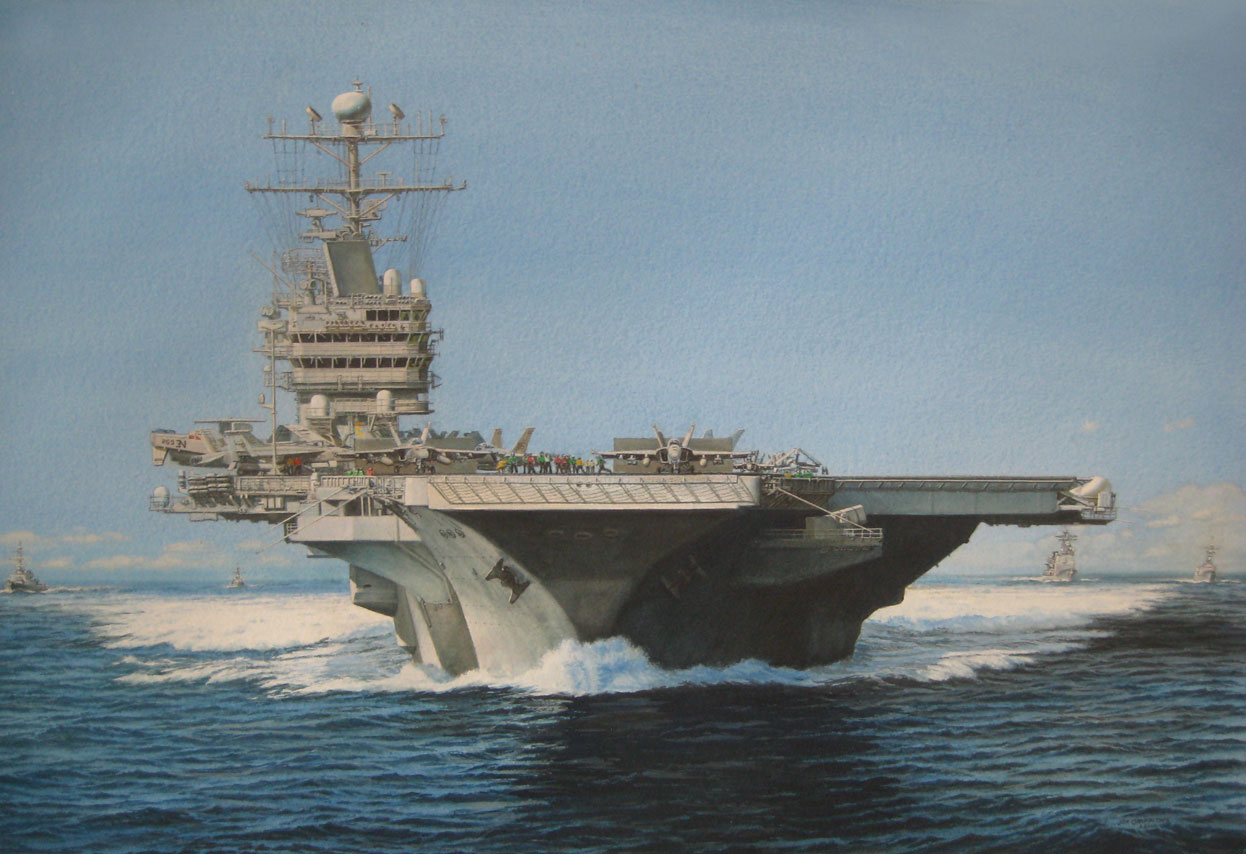
It wouldn’t be surprising if a viewer felt a rush of adrenaline upon seeing one of the more recent works in the book, “Power Projected” by Jim Griffiths. In this painting, the aircraft carrier USS Abraham Lincoln seems to resemble a spacecraft out of Star Wars, and that was the artist’s intention. “I wanted to find an unusual perspective when looking at the ship,” Griffiths explains. “The current Nimitz-class carriers are truly complex pieces of machinery, and I find them just fascinating.”
He adds, “Viewing these vessels from either head-on or astern, they look so unusual. I set up the composition of the painting so that the viewer would be drawn to the nose-on view of the jet, loaded with weaponry and about to launch. This is indeed ‘power projected,’ with both the ship and the aircraft heading straight at the viewer.”
Interested in U.S. naval aviation since childhood, Griffiths has amassed a substantial visual and textual reference library that he uses to prepare for his paintings, including the depictions of clipper ships from the mid-1800s for which the Glenview, Illinois, artist is best known. “I have never served in the military, but my heart is with the U.S. Navy,” he admits.
Establishing contemporary maritime art as central to the American story, A Maritime History of the United States is a vivid demonstration of the passion and commitment these artists have for their subject. It’s also a confirmation of the significance the water around us has had in the history of this country. Each image has its own individual perspective and vitality. Each captures a moment in history, whether it’s a depiction of events from the past or a documentation of the present that could likely become a historical reference in the future.
View contemporary landscape paintings here at RealismToday.com