
In this episode of Art School Live, Charlie Hunter gives a refreshingly practical approach to building a stronger drawing habit. The central message is wonderfully unglamorous: do not wait for perfect conditions, an impressive subject, or a burst of inspiration. Get out two or three times a week, sit somewhere comfortable, and make a sketch.
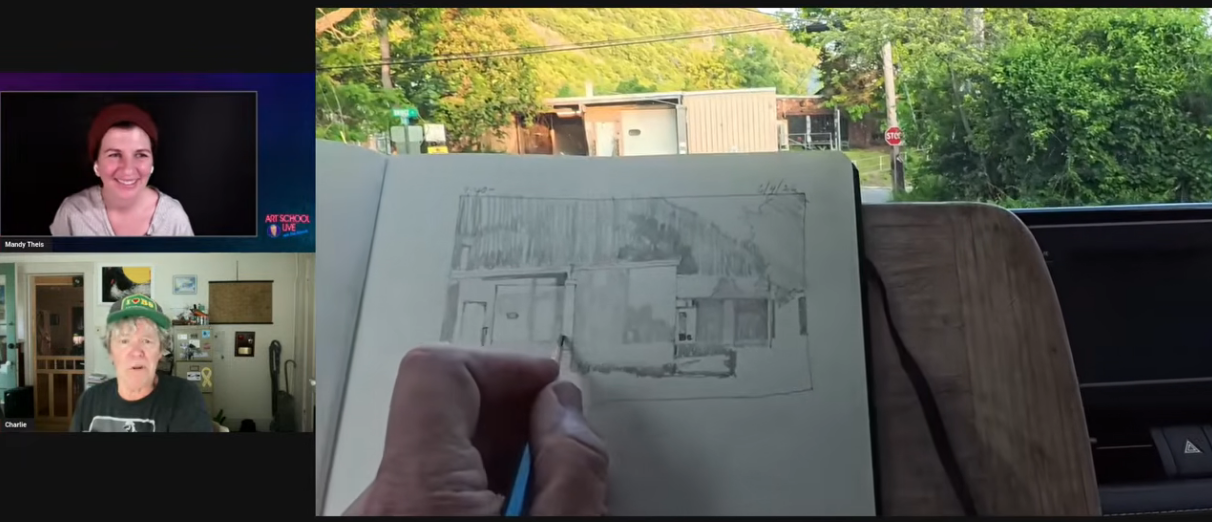
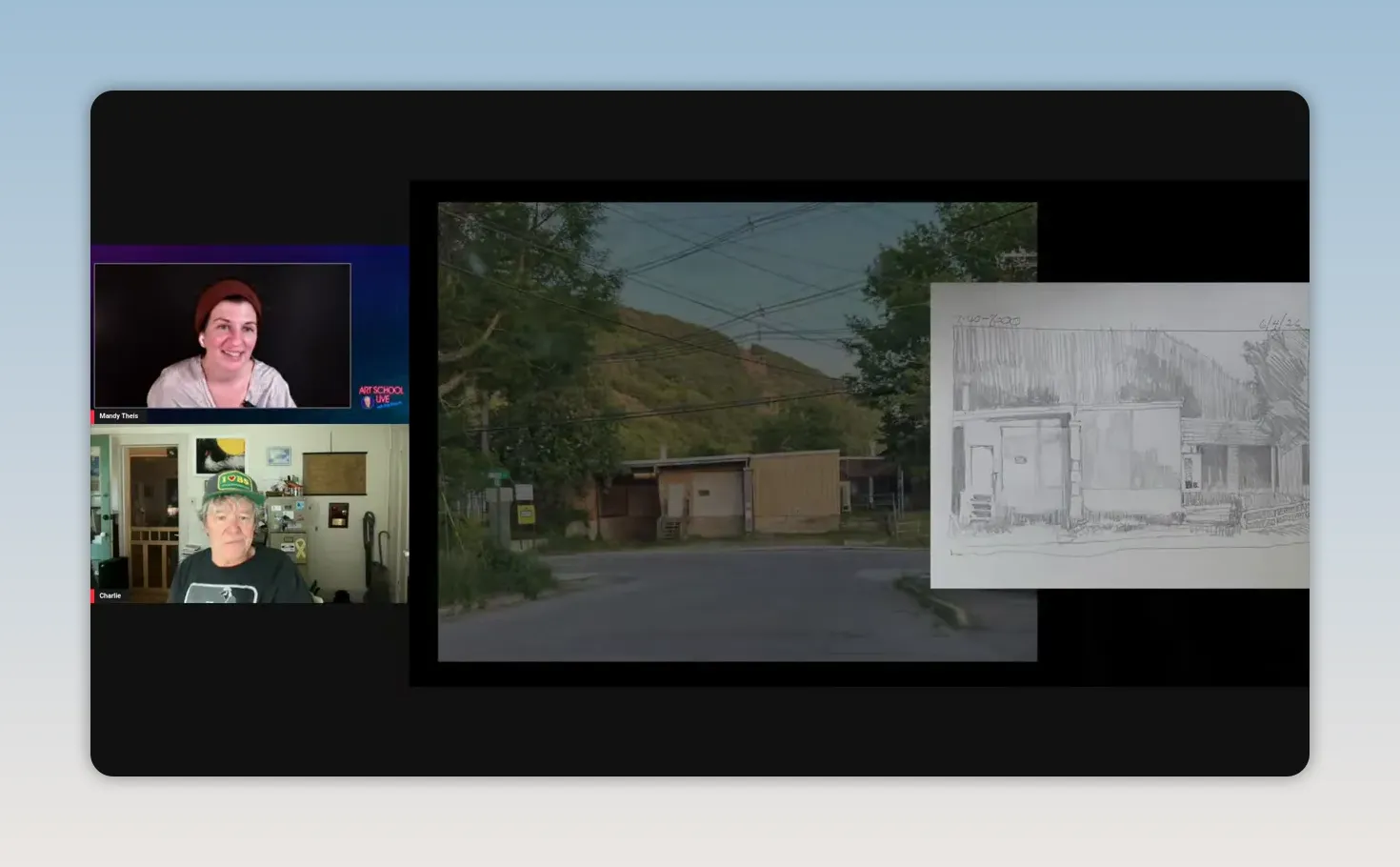
Hunter’s preferred setup happens to be his car. Using an old cutting board, D-rings, wire, foam pads, and a couple of supports for a sketchbook, he built a simple drawing board that hooks over the steering wheel. It gives him a stable surface at a comfortable angle, turning a parked car into a compact sketching studio. His demonstrated subject, an industrial building outside his Bellows Falls, Vermont studio, is deliberately ordinary. That is the point. A worthwhile sketching practice does not depend on finding postcard scenery.
Start Small, Keep It Honest
The sketch takes roughly 20 minutes. Hunter begins by drawing a rectangle on the page, immediately establishing the boundaries of the composition. That small decision eliminates one major source of paralysis: wondering where the drawing should begin and end.
He generally works sight-size, keeping the drawing approximately the size that the subject appears from his position. Instead of mapping every element, he begins with a clear, sharp junction, such as the corner where two building planes meet, and builds outward. The work is exploratory, not theatrical. An error gets erased and redrawn. Erasing is not evidence of failure. It is part of the practice.
Hunter compares these sketches to a musician’s scales. The goal is not to create a staggering work of heartbreaking genius every time pencil touches paper. The goal is to train the hand and eye so that, when it is time to paint, basic drawing decisions feel more familiar. Bad drawings are included in the deal. He estimates that plenty of them will be terrible, and that is fine. The useful response to the inner critic is simple: crumple up the toxic thought and put it over there.
Think in Big Shapes and Three Values
For this kind of direct sketch, Hunter uses a hard 3H pencil. It may seem counterintuitive, but its limitations help. Rather than offering an endless range of soft, expressive marks, the pencil naturally organizes the sketch around three values:
- The darkest dark
- A middle value
- The white of the paper
This restricted value structure prevents overwhelm. Hunter develops line and shading together because the shaded masses are the shapes. A building is not merely an inventory of windows, bricks, and loading docks. It is a collection of large value relationships that must work together across the picture plane.
Squinting is essential. Hunter recalls advice from his mentor Richard Schmid: stare at the painting, squint at reality. Making “snake eyes” suppresses distracting detail and helps the larger design emerge. It also exposes why architectural sketches can become cartoonish. Artists often draw what they know is there rather than what they actually see, exaggerating descriptive details until the scene becomes a list of symbols. The cure is practice and a commitment to the big shapes.
Let Marks Describe the Subject
The direction and texture of pencil marks matter. A smoothly shaded modern wall can call for an even tone, while a distant hillside benefits from looser vertical crosshatching that suggests trees. Horizontal marks across that hillside would contradict the observed structure and make it read like a carpet rather than a wooded slope.
Hunter also looks for visual elements that stitch separate parts of the picture together. A chimney can connect the building to the hill behind it. Debris, grasses, and the uneven earth at the base of a loading dock can connect an apparently rigid structure to the land it occupies. These transitions are what make a building belong to its landscape rather than appear pasted onto it.
Choose Subjects That Hold Attention
Hunter’s advice is to find one’s own subject matter. His interest lies in small-town American industrial and post-industrial landscapes, but another artist may be pulled toward florals, people, or something else entirely. A regular practice cannot survive for long if it feels like taking medicine.
He strongly favors working from life whenever possible. A photograph has already flattened the world into two dimensions, making it easy to slip into copying. Life offers an unfolding interval of light, atmosphere, and perception. Still, photographs have a place when the subject no longer exists, such as an historical industrial site.
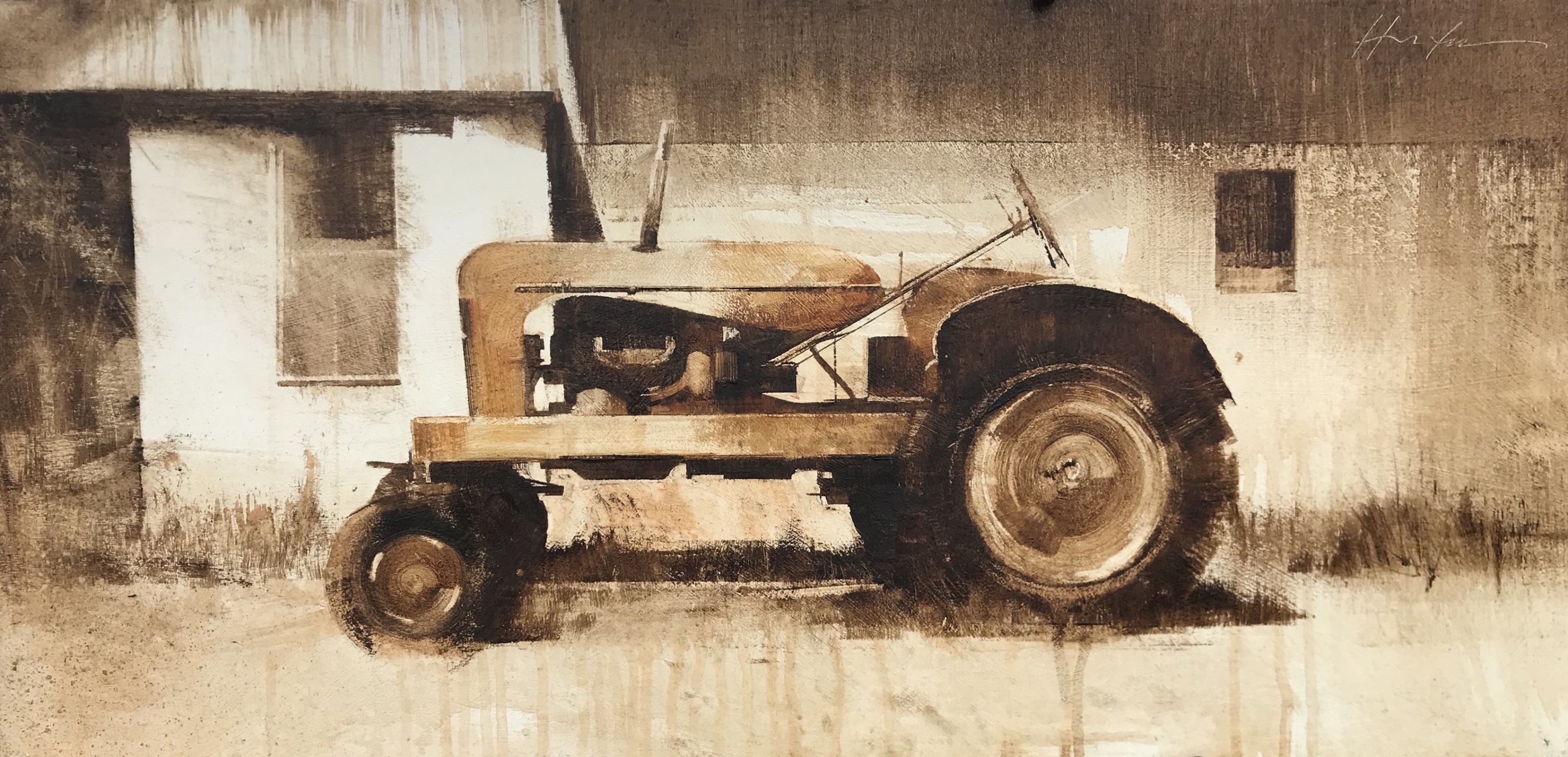
The demonstration also touches on Hunter’s painting practice, which differs from his pencil sketches. He often begins oil paintings with a warm brown monochrome layer, wipes out the large shapes with paper towels, then develops darker accents. He uses water-mixable oils to limit airborne petroleum-based solvents, while emphasizing that each artist should choose materials based on what best supports the story they want to tell.
Get on Base
The lasting lesson is not about a special pencil, a steering-wheel drawing board, or a particular subject. It is about repetition. Keep the session short. Use simple systems. Record the start and finish time if it helps track which light conditions work best. Stand farther back from complicated subjects when possible. Above all, do not demand a home run. Just get on base.
For the full good-humored conversation, the practical car setup, and a close look at Hunter building the sketch mark by mark, watch the complete episode of Art School Live above.
FeedSpot has selected Realism Today as one of the Top 20 Oil Painting Blogs on the web (FeedSpot, 2026)
Take your realism art to the next level when you attend Realism Live ~ a multi-day virtual art conference led by 20+ world class artists. (No tech skills? No problem! If you can click a link, you can join our event!) Learn more at RealismLive.com!
Blog post prepared for the web by Cherie Dawn Haas, Editor of Realism Today