
There is a lot of superb contemporary realism being made these days; this article by Peter Trippi shines light on a gifted individual.
Dustin Adamson (b. 1987) has come full circle. Born and raised in the San Francisco Bay Area, he spent years studying in San Diego and then New Jersey, but has returned home to paint and teach.
“Growing up in Silicon Valley,” he recalls, “I wasn’t exposed to much visual art beyond movies and videogames. The closest I got was doodling scenes from Star Wars and The Simpsons.”
Pixar films were popular during Adamson’s youth, so at San Diego State University he majored in multimedia arts and planned to work for an animation studio. Yet his favorite classes were not digital at all: printmaking and book-binding required working with his hands, which chimed happily with the summer construction jobs he took alongside his floor-layer father.
After graduation, Adamson enrolled at the Bay Area Classical Artist Atelier in San Carlos, where he studied with Justin Hess and Alicia Ponzio and then followed them to their own studio in San Francisco. “That was the first time I really learned to draw and sculpt,” he notes. Through Ponzio he learned to assess “form and anatomy from the perspective of a sculptor,” and through instructor Noah Buchanan a deeper grasp of anatomy. Adamson appreciates Hess teaching him to grind his own paints and prepare his own canvases, and for exhorting pupils to “make big, bold decisions, like how John Singer Sargent would describe an arm with a single brushstroke.”
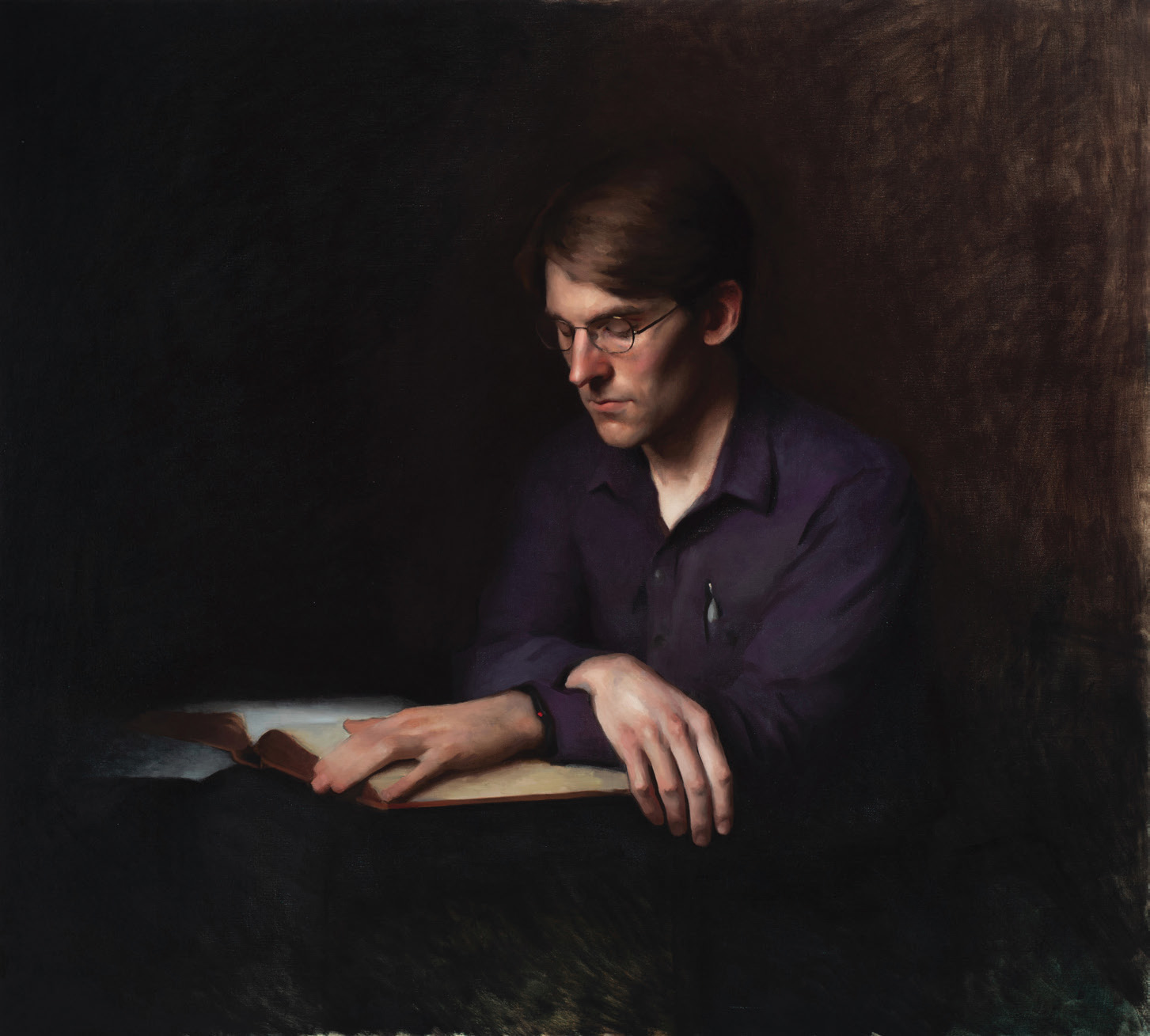
Equipped with this knowledge, Adamson headed to the Florence Academy of Art’s U.S. satellite — in Jersey City, just across the Hudson from New York. There he worked with instructors Jordan Sokol, Amaya Gurpide, Cornelia Hernes, and Stephen Bauman, relishing the “quietly intense” curriculum that entailed 9–10 hours in the studio most days, broken up by frequent field trips to the Metropolitan Museum of Art. Particularly impactful was the faculty’s directive to “stand back from our easels and closely observe the models, rather than immediately drawing or painting them.” Taking time to look still matters to Adamson, something we see plainly in the portraits and figures he paints today, along with the occasional still life. The overall visual impact of his work is quietude, and not just because he often works in monochrome (especially cobalt turquoise).
Given the omnipresence of photography, digital manipulation, and AI in our visual culture, Adamson understands that many viewers believe any realistic image has been heavily filtered by the time they see it. That’s why, “when I paint, I’m thinking about the representation of nature through a filter that is quite human.” He says, “I like to allow texture to build up and mistakes to show through while working, because I never really know when something special will come together. Some areas are quite tight, but others can be quite accidental. I enjoy letting that happen.”
Adamson continues, “Many people are worried about how AI will affect the art world, but we should remember there is a long history of technological disruptions that ultimately benefited artists and art. Just for example, the advent of photography allowed 19th-century artists to create more dynamic realist works (think Thomas Eakins), and of course the impressionists were liberated by the camera.”
Since college, Adamson has enjoyed studying past masters; in school his heroes were Rembrandt, Velázquez, and Sargent, and now it’s J.W. Waterhouse, Edgar Maxence, and Jules Bastien-Lepage. (The latter’s “Joan of Arc” is a favorite, always on view at the Met.) He also admires turn-of-the-century photography by such talents as Alfred Stieglitz and Gertrude Kasebier, noting that “the way they saw light and atmosphere was so painterly.” As for artists working now, Adamson is a fan of Colleen Barry, Zoey Frank, Andrew Hem, and Nicolas Uribe.
Asked for his take on the contemporary realism art scene today, Adamson notes that the Internet has made it easy for prospective students to find and enroll at ateliers across the country. That means “there are lots of classically trained artists out there, and in the Bay Area they are now teaching at the community college level. This is a wonderful development because soon there will be many more people with either the technical ability or the visual literacy needed to appreciate fine art.” It’s an often-overlooked point that should make us all hopeful.
This article was originally published in Fine Art Connoisseur magazine (subscribe here).
Take your realism art to the next level when you attend Realism Live ~ a multi-day virtual art conference led by 20+ world class artists. (No tech skills? No problem! If you can click a link, you can join our event!) Learn more at RealismLive.com!
Story prepared for the web by Cherie Dawn Haas, Editor of Realism Today