
There is a lot of superb contemporary realism being made these days; this article by Brandon Rosas shines light on a gifted individual.
Working in Madrid, José López Vergara (b. 1994) draws inspiration from art history to idealize modern life in timeless compositions. “I’m very attracted to the raw shapes and design of antique art and the first representations of the human figure,” he says. “The iconography in my work comes from a mixture of influences and my desire to simplify shapes.”
Vergara first developed an interest in classical painting on a childhood trip to the Museo Nacional del Prado, where he was exposed to masterworks by Diego Velázquez and Peter Paul Rubens. “I was around 8 or 10 years old, and that visit left a mark,” he remembers. “One painting I saw, Rubens’s ‘St. George and the Dragon,’ inspires me to this day.”
Around that same time, Vergara suffered an accident that permanently impaired the movement of his dominant arm. “Fortunately, it didn’t prevent me from holding a pencil or a brush,” he affirms. “More than anything, the accident pushed me to draw more and to prove that it wouldn’t be an obstacle.”
Vergara achieved viral fame as a teenager when his hyper-realistic colored pencil drawings won a contest on Instagram and were subsequently shared by celebrities and news outlets worldwide. “It was an extraordinary experience, but those drawings were just a technical exercise,” he notes. “After all the fuss disappeared, I started working on my actual interests and realized I had to find a way to make paintings like that Rubens I saw at the Prado.”
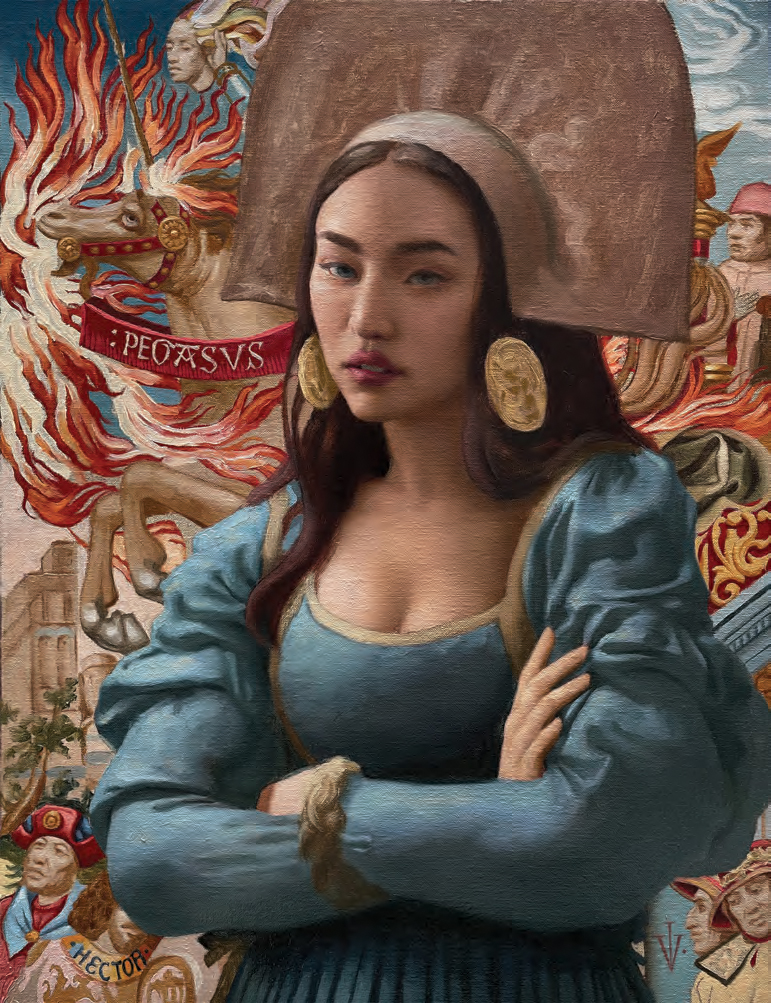
After six years of classical study — three at Florence’s Angel Academy of Art and three at the Grand Central Atelier in New York City — Vergara now creates arresting compositions that pay homage to the great artists of the past while speaking to present-day collectors. “Pegasus,” illustrated above, is from a recent series that depicts fierce-looking women posed in front of medieval tapestries while wearing headpieces that signal their status in the fictional worlds Vergara creates.
“For the background, I referenced a tapestry from 1520 titled ‘Fame’ that shows Perseus riding fire-breathing Pegasus and holding the severed head of Medusa, which I think fits the model’s attitude perfectly,” Vergara explains. “To me, both the figure and the tapestry represent strength, power, seduction, mystery, and beauty.”
Through a blend of Renaissance techniques, medieval heraldry, and modern attitudes, Vergara hopes to create work that will outlive its present context. “I think true art transcends cultures, religions, ideologies, and even time,” he declares. “I want to create something pure that can be enjoyed now and in a thousand years.”
Connect with the artist at www.joselopezvergara.com.
This article was originally published in Fine Art Connoisseur magazine (subscribe here).
- Become a Realism Today Ambassador for the chance to see your contemporary realism work featured in our newsletter, on our social media, and on this site.