
This episode of Art School Live features special guest host Kathleen Hudson and artist Jen Starling for a focused oil painting lesson on a deceptively simple subject: the lemon. But as Starling makes clear, it is not really about painting a lemon. It is about learning to see light, shadow, value, temperature, and the subtle transitions that make a flat painting feel three-dimensional.
A Lemon Is a Lesson in Form
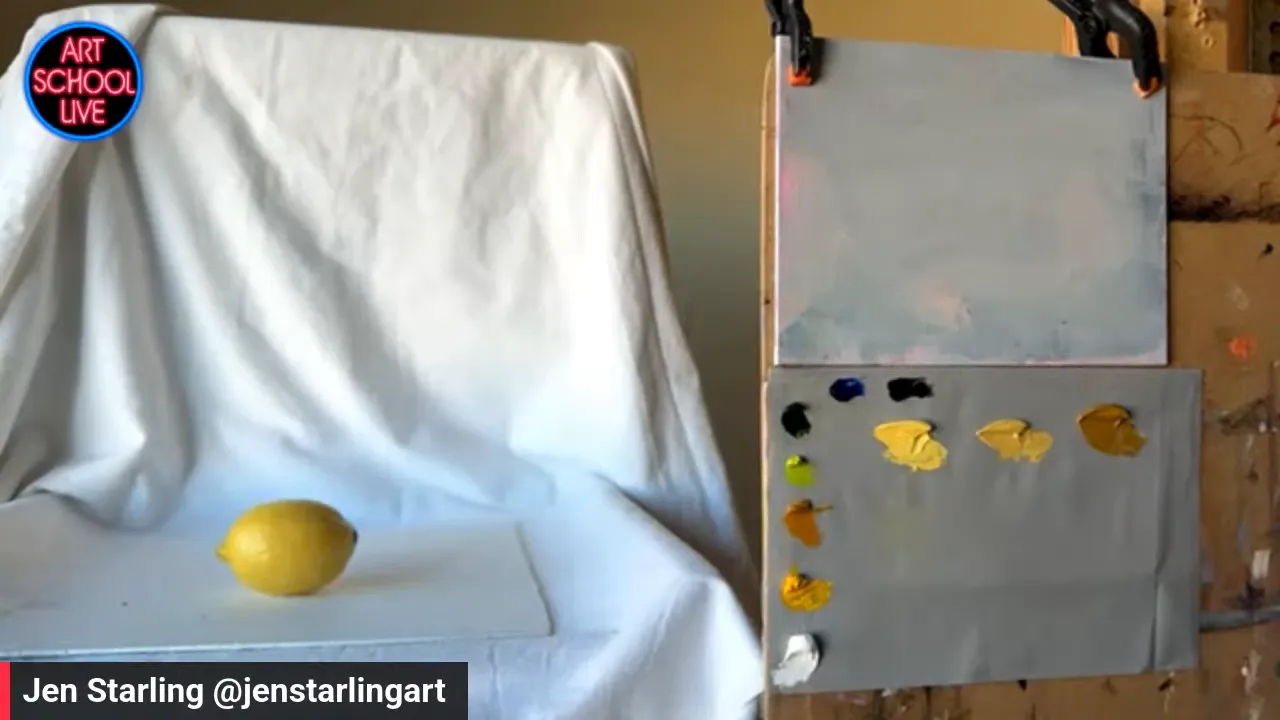
Starling begins by using a black backdrop around the lemon to reduce reflected light. This makes the major light shape, form shadow, core shadow, cast shadow, highlight, reflected light, and accent dark much easier to identify. Once the black fabric is removed, the white setup floods the shadow side with bounced light, making the core shadow far more subtle.
The essential tool for sorting it out is a serious squint. Squinting removes distracting surface detail and consolidates the values into larger, more understandable shapes. That practice applies far beyond still life, whether the subject is a portrait, a rounded rock outdoors, or clouds in a landscape.
Paint Value Shapes Before Details
Starling recommends beginning with simple mixtures and organizing the palette from light to dark. Her shadow mixture uses yellow ochre and sap green, while the light mixture begins with titanium white and cadmium yellow. Mixing those two piles produces a harmonious midtone, with additional color added only as needed.
The bigger point is to keep the first pass simple. A monochrome study can be especially useful because it removes color from the equation and trains the eye to understand value and transitions. Before adding the dimples, tip, or other lemon details, the form must read as round.
Lose Edges to Create Harmony
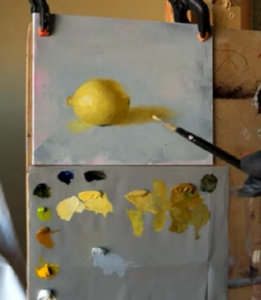
One of Starling’s most important ideas is to merge the form shadow into the cast shadow rather than outlining the object. A hard contour around the lemon may feel accurate, but it can quickly become graphic or cartoonish. In nature, the eye sees connected value shapes, not lines around every object.
The accent dark near the lemon’s base gives enough definition to anchor the object, while the cast shadow stays sharpest closest to the lemon and softens as it moves away. This strategic loss of edges gives the painting flow, weight, and atmosphere. The goal is not photographic copying, but to create a convincing, beautiful painting where the story is light falling across a form.
Keep Reflected Light Under Control
Reflected light is exciting, but it is also easy to overstate. Starling cautions that it should almost never become as light as the direct light side. Comparing it, while squinting, against the midtone and light shapes keeps it in the proper value range. It can add life and nuance without breaking the illusion of form.
For artists ready to deepen these observational skills in an immersive realism-focused setting, Realism Live 2026 offers a powerful next step, and Jen Starling is on the faculty this year! Great painting begins with great seeing, and this lemon study is proof that the fundamentals are anything but basic.
FeedSpot has selected Realism Today as one of the Top 20 Oil Painting Blogs on the web (FeedSpot, 2026)
Take your realism art to the next level when you attend Realism Live ~ a multi-day virtual art conference led by 20+ world class artists. (No tech skills? No problem! If you can click a link, you can join our event!) Learn more at RealismLive.com!
Blog post prepared for the web by Cherie Dawn Haas, Editor of Realism Today